

As I waited in line with my friends and another group of students, I noticed that the elevator took a while to reach the lower level of the Multi-Disciplinary (MD) building.
After a lengthy wait, the elevator doors finally opened and we stepped into a cramped space that could barely fit five students. As it went up, the elevator emitted clanking, rattling, and grating noises.
To ease the tension, we all joked about the elevator malfunctioning
Deep down, we feared that something might happen during our ride. The doors opened, and I felt a sense of relief.
The ride made me think about the slow elevator in the Natural Science (NS) building, making it faster to use the stairs to get to the third floor.
It also made me analyze how this elevator and others around campus can fail or be unhelpful to students, especially those with disabilities.
Slow elevators can cause students to be late, leading them to miss out on the information given at the beginning of class. The alternative would be to take the stairs, but what about the students who cannot use the stairs?
Students without disabilities can take the stairs to class, but without reliable elevators, those who can’t do so might miss valuable class time due to slow elevators.
Elevators are a vital resource for students with disabilities, so having an unreliable or unsafe elevator can affect their academic performance. Without elevators, students cannot get to class at all.
Twenty-one percent of undergraduates and 11% of post-baccalaureate students reported having a disability, according to the National Center for Education Statistics. That’s a significant number of students who likely depend on elevators to get to their upper-floor classes.
If the elevator breaks down, one option might be to have disabled students complete their work online, but this still reduces their learning experience.
It is essential to recognize that in-person classes are helpful for any student who cannot learn through online courses. An undergraduate survey revealed that 67% of students struggle with remote learning.
Students who need the elevator cannot be pushed aside and left wondering how they will get to class. Speed concerns aside, the college must ensure every elevator is regularly inspected and safe.
The elevator from the MD building was last inspected in November 2024, but it still sounds unsafe to use. The previous inspection for the elevator in the NS building was in August 2023, and the permit expired in August 2024.
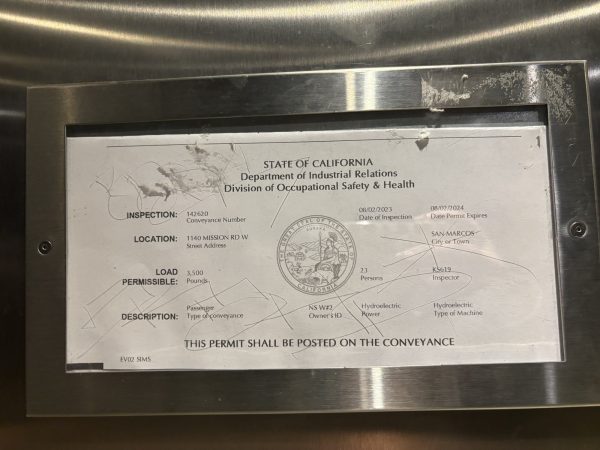
This raises serious concerns about whether campus elevators are inspected often enough to ensure safety.
Any device that carries people needs regular inspections, especially when a small failure can have serious consequences.
Equipment like this must be kept in good working order so that students can have safe, reliable transportation to classes that are not on the lower level of a building.
The elevators in these buildings are slow, which can cause delays. Students with disabilities or those who can’t take the stairs deserve reliable transportation. By law, all students deserve a safe and well-managed elevator.
Students should contact Palomar’s governing board to demand regular elevator inspections. Every student deserves a safe and accessible campus.