
Read in Spanish here | Lee en español aquí
SAN MARCOS — As Immigration and Customs Enforcement (ICE) activity increases in North County and across the nation, it is important to be aware of Palomar’s policy and procedures regarding ICE on campus.
Palomar officials say the school’s response centers on routing agents through campus leadership and police to verify any legal paperwork and share accurate information. Assistant Superintendent/Vice President of Student Services Nick Mata and Palomar’s Chief of Police Chris Moore outlined the college’s procedures in the event ICE officers are present on any Palomar campus.
“If you see someone on campus or whatever and you’re not sure, just call campus police,” Mata said. “It’s better to be safe than sorry. We can go look into it and then we can be like, ‘Okay, no, this isn’t an issue.’ Because, you know, as we know, sometimes immigration enforcement isn’t in a uniform.”
Upon receiving a report that ICE may be on campus, Palomar College Police Department (PCPD) will respond to the location to confirm and gather information.
Immigration enforcement will first need to go to the admissions office and inform them why they are there. PCPD will then notify the President’s Office and the director of financial aid. They will review any official paperwork, such as a warrant or court order, and upon verification, will permit ICE agents to proceed with necessary action.
If ICE is present on campus, Chief Moore said that Palomar’s Public Information Officer Julie Lanthier Bandy, would be informed and would send a campus-wide email notifying the campus community of ICE’s presence and explaining its purpose.
“One of the main goals as well is also making sure we’re getting accurate information out. The last thing we want to do is send something out: ‘ICE is on campus.’ Right? And it instills this fear,” Mata said. “But if we can send information out that says, ‘Yes, ICE is or was on campus, but here’s what they were here for, they engaged with campus police or college authorities for that process, and then they left.’ ”
The Behavioral Health Counseling Services is hosting a support hour on Feb. 9 from 2 p.m. to 3 p.m. in room MD-155C for those affected by immigration policies.
Since the beginning of the academic year, Palomar College has shared ICE protocols with staff and faculty through training and emails on Administrative Procedure (AP) 3415: Immigration Enforcement Activities.
AP 3415 states that district personnel should advise all students, faculty and staff to notify the office of the President and campus police if they have information that ICE will or has entered the campus. It outlines how the campus community should interact with ICE Officers and procedures to follow if someone is being detained.
“If you were in a classroom setting, within that 3415 and some of the languages, the government doesn’t have access to protected places. And really, a classroom, like someone can’t just walk into a classroom and sit down. So that would be an area that students could feel comfortable in,” said Moore.
Despite this, union leaders and community members have expressed that they don’t feel it’s enough. At the November regular governing board meeting, English as a Second Language (ESL) Department Co-Chair Nicole Siminski took to the podium for public comment, criticizing the administration and board after a Telescope op-ed revealed ICE support from then-Governing Board President Jacqueline Kaiser. Siminski spoke about recent ICE activity and her experience with student fear during the first Trump presidency.
“This fear seems so small compared to the fears now. Luckily, at the time, I had a memo from the former Palomar College president, Joi Blake, reaffirming the safety of our students at Palomar, regardless of status, and took comfort sharing this with all my students every semester,” Siminski said. “That memo was never updated, and that safety has not been reaffirmed.”
PCPD has collaborated with the ESL program previously at the Escondido, San Marcos and Fallbrook campuses, according to Chief Moore. He explains that his team provides guidance on Constitutional rights and that half of the officers speak Spanish.
“But that’s something we’ve been very intentional about, is working with ESL folks to just say, hey, this is a safe place for you to get educated.”
As the semester started, Palomar Faculty Federation Co-President Lawrence Lawson sent an email to all campus leadership, demanding clearer procedures and policies for the campus community, specifically students, amid increasing unrest, ICE support from the governing board trustee, and an incident at SDCCD.
“These incidents, and many more, cause fear on campus, and that fear is looking for assurance, guidance, and solutions from campus leadership,” Lawrence said. “The Unions have helped fill that vacuum of leadership for employees under our purview as best we can, but students need more from you. We do too.”
Among the union’s demands is a request to expand the area covered by notifications to a one-mile radius around campus, matching the policy in place at California State University San Marcos.
Currently, Palomar will send an alert only if ICE is on college property or in the immediate surrounding areas, such as the gas station or transit center. Both Chief Moore and Public Information Officer Julie Lanthier Bandy confirmed that any notification sent would be limited to campus property and immediate areas.
“So unfortunately when we get the alert about the Home Depot on San Marcos Boulevard it’s in close proximity that would give anxiety people can I see it driving in but that’s not a part of the law,” Moore said. “So if it was a mile away in a park, we may get alerts about it, but we may not go check it out because it’s not on campus. And so that’s where we just want, you know, we’re not the hub.”
Lanthier Bandy added that the district’s jurisdiction is limited to Palomar property.
Another contested topic was the availability and ease of access to resources. Chief Moore outlined what is available for students and the wider community.
“We’ve also provided, through the Dream Center, legal resources for students, and maybe their parents have been detained or something, but we’ve provided legal resources as well that direct them to how to find out what’s going on,” Moore said.
Mata noted that, due to increased immigration enforcement, there is currently a two- to three-week wait to speak with someone about these legal resources at the Dream Center.
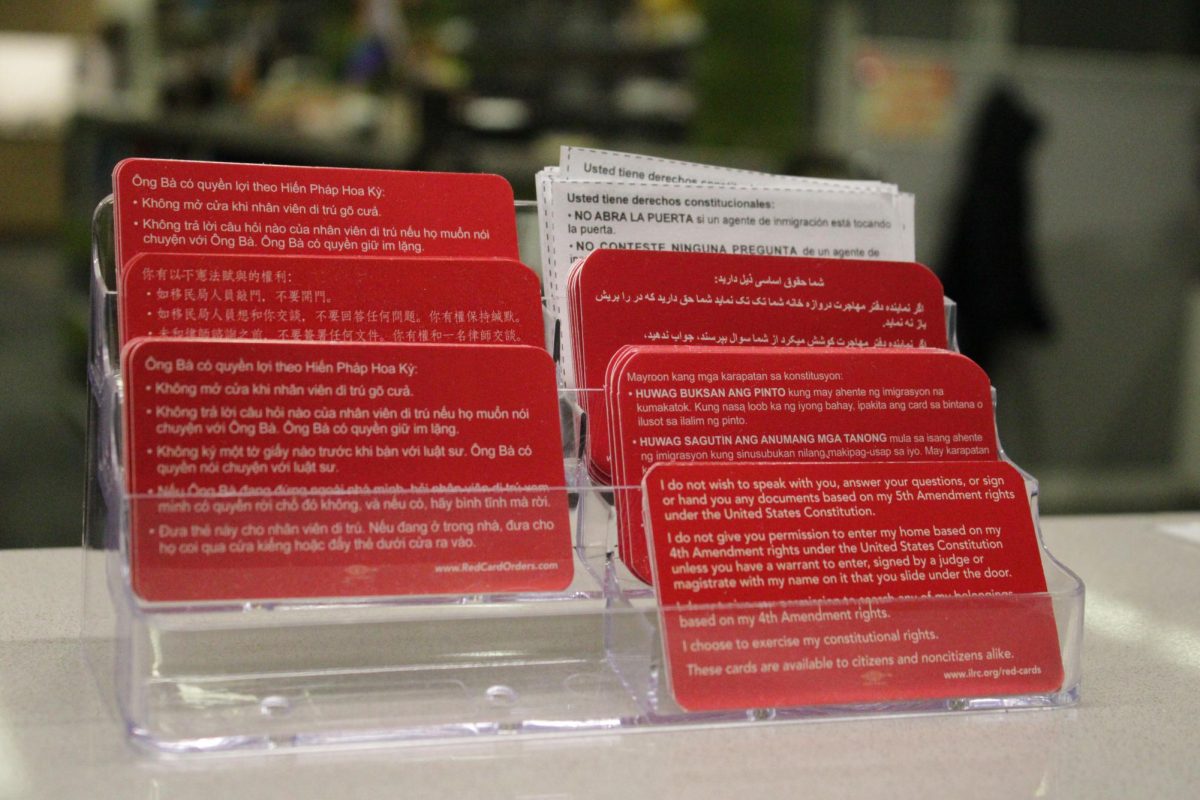
Additionally, Faculty, staff, and students can find red “Know Your Rights” cards at the Learning Resource Center. Mata also encouraged students to contact his office for more help.
“We want each student to understand what their personal risk is in regards to coming to campus or attending school. And If they feel that they’re at risk, like they’re afraid to get on public transportation or they’re afraid to be on campus physically, I encourage them to reach out to me, to reach out to my office, and we can work with that student,” Mata said.
Chief Moore assured that PCPD does not participate in immigration enforcement and said its duty is to protect the campus and its students. This is covered by California Senate Bill 54.
“We don’t have any communication with ICE. And just to remind your readers, you know, campus police, Escondido police, the sheriff have nothing to do with immigration enforcement. There’s an AB or SB 54 that goes in very specific that it’s illegal for the police to give information and to assist with ICE efforts.“it’s like against the law so i just want them to know that you know we’re kind of the good guys in this and uh we’ll protect the campus from from any concerns,” Moore said.
On Sept 20, Governor Gavin Newsom signed a notification amendment to California Senate Bill 98 (SB 98). The amendment requires that students, staff, and faculty be notified as soon as possible if ICE is on school property.
SB 98 also states that if a student, staff member, or faculty member is suspected of being taken into custody, the college or university must notify the person’s emergency contact immediately.
By March 1, all elementary, secondary and postsecondary institutions are required to have an easily accessible policy.
According to SB 98, “those plans to include procedures specifically designed to notify parents and guardians of pupils, teachers, administrators, and school personnel when the school confirms the presence of immigration enforcement, as defined, on the schoolsite.”
With the SB 98 notification add-on, Mata plans to update training to include it. He said the college is currently working on getting a final legal review.
“Students should know that Palomar College is committed not only to their success here at the institution, but also committed to their safety.” Mata said.