

SAN MARCOS — From the removal of the land acknowledgment to the deletion of Board Policy 3000, the public voiced their frustrations at the Nov. 5 Palomar Governing Board meeting.
In April of this year, the governing board voted 3-2 to stop reciting the land acknowledgment at every board meeting. Since June, the Council of Classified Employees (CCE) has been asking for a cost-of-living adjustment (COLA), which the union claims is due per their contract while the district argues it isn’t. Most recently, at the Oct. 14 meeting, the board voted 3-2 to eliminate its anti-racism policy, BP 3000.
Since the removal of the land acknowledgement, community members have taken the opportunity to read it aloud during the public comment section of the governing board meetings. At the Nov. 5 meeting, Palomar Faculty Federation Co-President Lawrence Lawson stepped up to the podium to read it and also added a remark with a pointed tone to his voice.
“You voted to remove this, you put into action the knowledge that these words were spoken for a very long time, and still are, without a lot of action. So, I want to thank you for letting us realize that this college and all of us weren’t doing enough to put action to these words, and spurring us to do so,” Lawson said.
The criticism regarding the elimination of BP 3000 continued during this meeting. The process of its removal has caused frustration. Many are upset that the policy was only talked about for the first time concerning its removal at the last meeting, without any public review of the policy.
“So when I hear that BP 3000 was deleted because of a concern for hypothetical lawsuits, it raises an obvious question. If preventing litigation was truly the goal, why hasn’t the board taken any meaningful steps to prevent the very real, highly predictable, and legally imminent lawsuits related to ADA Title II? It appears that the removal of BP 3000 had nothing to do with legal risk management, and everything to do with serving an external political agenda,” Disability Resource Center counselor Alyssa Vafaei said.
A ninth grader from Mission Hills High School expressed her disappointment with the removal of BP 3000 and told the board that other students like her are reconsidering attending Palomar College in the future.
“Students at San Marcos High School, Escondido High School, Twin Oaks High School, you name it. We will be the ones choosing where we take our classes, where we invest our time and money for many, many years to come, and it is my goal to make sure we are all watching,” she said. “I would love to bring back the good news to my fellow district high schoolers that you all did the right thing, and were activists and allies standing up for equity and anti-racism for all of us. I’m 14, and if I can do it, so can you.”
Frank Xu, who was a candidate for the governing board in 2022, expressed his gratitude to the board via Zoom for their decision to remove BP 3000.
“You give me hope that Palomar College is still an educational institution that allows diversity of thoughts to thrive,” Xu said.
Xu also highlighted the article from The Telescope regarding BP 3000, calling it misleading.
“In the news, The Telescope ran a story with a misleading subtitle. ‘Palomar’s Governing Board votes to remove BP 3000, leaving the campus without a board-level stand against racism.’ This is a clear example of confusing a basic, uncontroversial value and contested ways to achieve that value,” Xu said.
As part of his criticism, Xu referenced BP 3410 (Nondiscrimination) and BP 3420 (Equal Employment Opportunity) to argue that The Telescope’s subheadline overstated the effect of the BP 3000 vote. Both policies prohibit discrimination across protected classes and govern access and hiring. BP 3000, by contrast, had framed an explicit anti-racism commitment and directed proactive measures at the board level.
CCE Vice President of Membership Jena Kruhmin spoke on the ongoing COLA dispute between the district and classified employees. She said approving the COLA would generate positive publicity for the board.
“We’re not asking for a bonus or a luxury, we’re asking to keep up with inflation. Only 2.3%, that’s it. So let’s fix it. Let’s have a headline that says, ‘Palomar College Governing Board votes unanimously to support classified staff with the full COLA.’ That’s good publicity. That’s leadership. That’s the kind of decision people remember and appreciate,” Kruhmin said.
Every year, Palomar College organizes Political Economy Days, featuring a series of lectures that cover subjects like politics, economics, and history. These lectures are presented by Palomar faculty and also include speakers from other institutions, such as San Diego State University and California State University San Marcos.
Trustee Yvette Acosta asked for a presentation on the selection process of speakers and a list of participants from the last five years during the October meeting. Faculty are concerned over the reason behind this request.
“What are you going to do with this list of faculty? Are you going to blackmail them? Are you going to do something to them related to their performance reviews? That’s a very frightening thing,” said Beth Sullivan, community member and former educator.
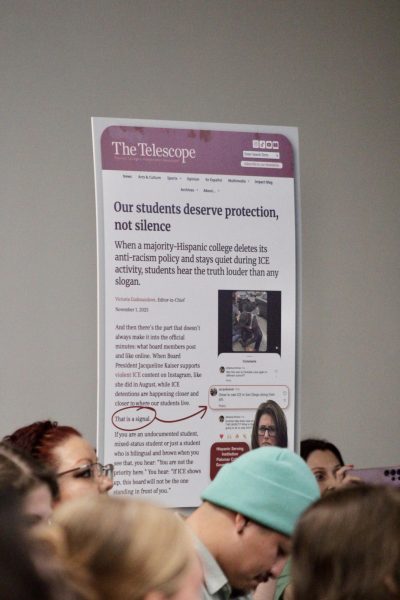
Faculty and staff also voiced their disappointment regarding a social media comment made by Governing Board President Jacqueline Kaiser, which appeared in a recent op-ed by The Telescope. On an Instagram video showing a man being detained by ICE in Encinitas, Kaiser commented, “Great to see ICE in San Diego doing their job.”
“Trustee Kaiser, that article was a gut punch. I’ll admit that it was not surprising, but it was a sobering reality check. To our other trustees, your personal stance on immigration is between you and your God. I’d ask you to consider who would Jesus deport,” said Nicole Siminski, chair of the English as a Second Language department.
Siminski also mentioned that during President Trump’s first term, when students were worried about their immigration status, former Palomar president Joi Lin Blake guaranteed the safety of all students at Palomar, regardless of their status. Siminski felt reassured by that promise and pointed out that since then, students’ safety has not been reaffirmed.
CCE President Anel Gonzalez shared her thoughts on Kaiser’s social media comment, highlighting that many students at Palomar identify as Latino or Hispanic, and that comments like these from a board president can damage students’ trust in the college.
“Our customers are our students. If they lose trust in the college leadership, we lose enrollment, we lose reputation, and we lose our purpose. Palomar’s values are not just words on papers,” Gonzalez said.
Board President Kaiser was not present in person but participated via Zoom and addressed the social media comment.
“I just want to briefly address, I know my name has been brought up in some regarding an article that appeared in The Telescope, and you know, that was missing context, so I guess if I were to add a little context to that, I would just make the statement that Trustee Kaiser’s family has more than once been the victim of criminal illegal activity at a great physical cost and financial cost to her family. So, there’s always two sides to every story. Sometimes it pays to take the extra step and to really hear other competing viewpoints as well. Thank you.”