
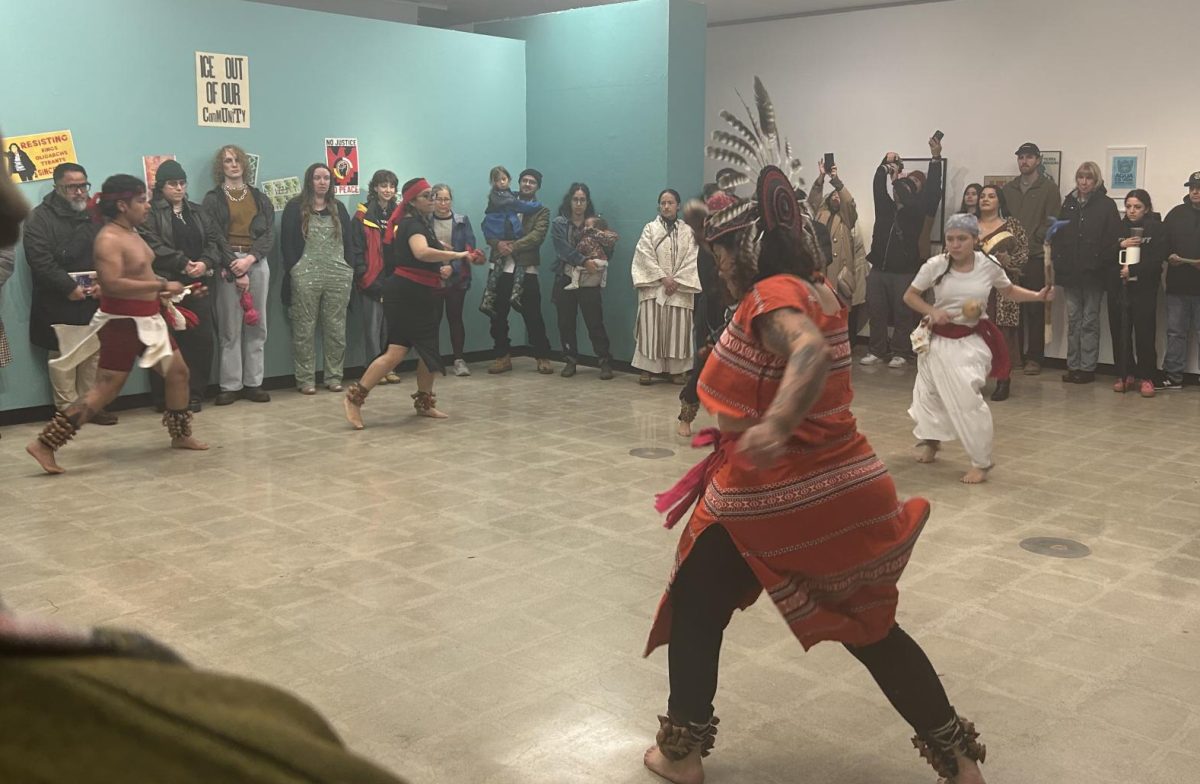
SAN MARCOS — Printmaking demos, artist performances and panel talks drew crowds of students and community members to the two day opening of “Systems Under Pressure” exhibit put on by North County ethnic studies departments.
The exhibit, a collective project between MiraCosta College, California State University San Marcos (CSUSM) and Palomar College, opened in the Boehm Gallery on Feb. 19 and will be open to visitors through April 18.
The opening featured a Danza Mexica blessing ceremony from local Indigenous group Calpulli Omeyocan and poetry readings from Palomar students and professors of Ethnic Studies at Palomar and CSUSM. Both performances underscored themes of intersectional resistance and reclaiming Indigenous traditions under the oppression of colonial systems.
Boehm Gallery Director Ryan Bulis describes the partnership as “an intersection between printmaking, ethnic studies and social justice.” The description of the exhibit emphasizes the ability of printed visual acts of rebellion to create fissures within oppressive systems that expose their vulnerabilities.
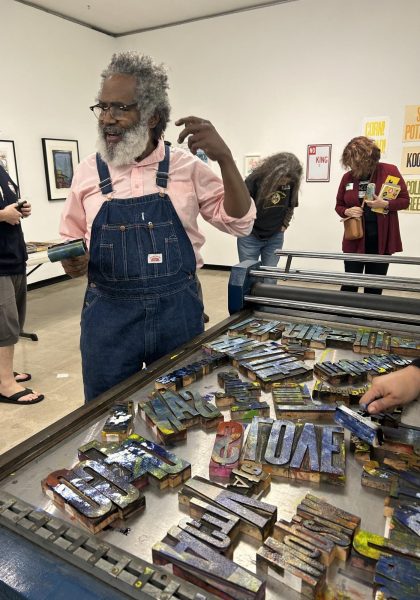
The exhibit features two renowned artists: Amos Paul Kennedy Jr. and Malaquías Montoya, a professor emeritus of University of California, Davis. Both artists use vibrant imagery and text to amplify voices that are not represented in traditional structures of power.
Kennedy Jr. uses hand presses, oil based inks and affordable chipboard to create prints inspired by proverbs, quotes and slogans. The process produces a unique image every time. He stressed the unique accessibility inherent within print that allows him to amplify his message.
“For me, printing democratizes, it’s a democratizing act, because I can make multiples and share them with people,” Kennedy Jr. said.
Kennedy Jr. credited Black Freedom Movement leader Ella Baker and his father as primary influences on his own ideology. He also said that his background in computer programming gives him a unique lens that informs his work and could be a reason he gravitated toward letterpress printing. Now he is fully immersed in his art and jokingly brags to be “on the cutting edge of 19th-century technology.”
Montoya, recognized by historians as one of the founders of the social serigraphy movement in the Bay Area, uses a stenciled mesh screen to transfer layers of colored ink onto a printing surface with a squeegee. He credited his late mother’s “resourceful” artistic technique as his inspiration. He recalled her decorating the interior of his Albuquerque childhood home using homemade “earth-paints” and tire tread for stencils.
Marisa Salinas, gallery attendee and professor of sociology and criminology at CSUSM called Montoya a pioneer of radical art in the Chicano community. She said the timeless and intergenerational nature of the exhibit is especially relevant now.
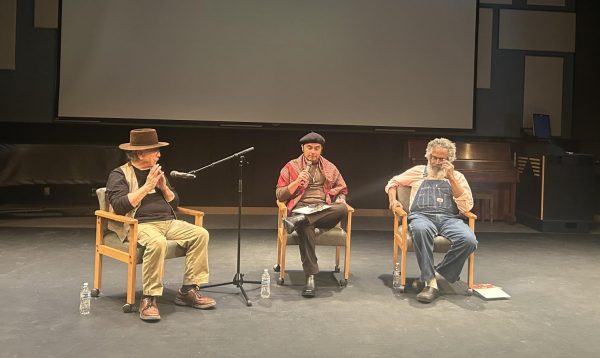
The artists spoke on their works and role in the community in a panel interview at the symposium on Feb. 20.
“When I first started printing, I realized the voice of my people was missing, despite the fact that my ancestors’ labor built the wealth that so many people enjoy today,” Kennedy Jr. said.
When previously asked by academics at the California College of Arts about his gallery, Montoya joked that his gallery is on the telephone poles and fence posts across the city of Oakland.
Montoya began using his talents for the Third World Liberation Front‘s call for the creation of an Ethnic Studies department on his campus at UC Berkeley in 1968, and has since printed his support for campaigns protesting the death penalty, exploitation of immigrants, police brutality, the Vietnam War, incarceration and the trials of the San Quentin Six. While speaking about his work for the Six, Montoya’s wife, Lezlie, briefly interrupted the discussion to remind him that the inmates had passed around a folded copy of his art in prison.
“All art is political, it just depends who you want to propagandize for,” Montoya said.
This theme can be seen throughout both artists’ featured works on the walls of the Boehm exhibit.
The symposium also featured demonstrations and interactive workshops led by artists Montoya and Kennedy Jr.
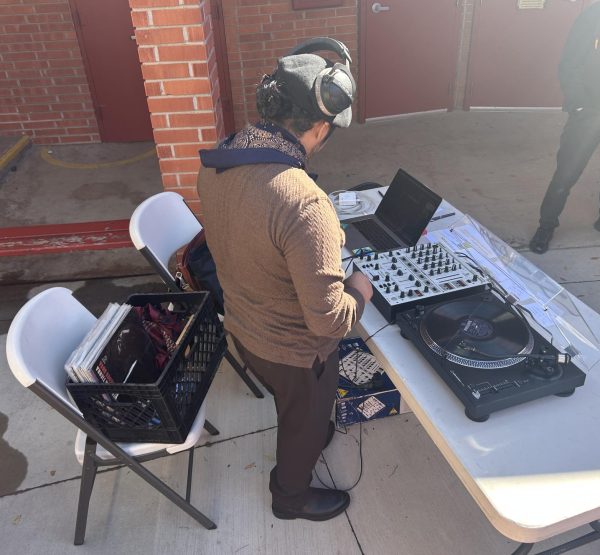
The event closed with a “Community Artivist Fair” that included booths from various Palomar College and CSUSM vendors set against the backdrop of event organizer Marcelo Garzo-Montalvo’s “liberation mixtape.” The list of organizations included Palomar Bravura literary journal, CSUSM ethnic studies department, and many others.
The event was attended by a diverse group of students, professors from local colleges and members of the community.
Garzo-Montalvo, professor of ethnic studies at CSUSM, attributes the success of the event to the efforts of the Ethnic Studies and art departments across the three campuses, and hopes the event challenges his peers to “think beyond academic disciplines and understand that we have a position in our communities that should be leveraging our institutions into places of gathering.”