

SAN MARCOS — The Palomar Library on the San Marcos campus is a four-story resource center for students. It offers a variety of resources from textbooks to private quiet study rooms.
Alex Doyle Bauer, an outreach librarian and associate professor, has been part of the Palomar community since 2016.
Bauer started her career in sales after high school, which allowed her to travel the world. However, upon learning that her boss was offering raises to only those with college degrees, she submitted her two-week notice and began her college journey.
While at MiraCosta College, a professor encouraged her to pursue a master’s degree, leading her to transfer to California State University, San Marcos (CSUSM), where she worked in the library and began considering a career as a librarian.
Bauer earned her master’s degree online from San Jose State University, interned at MiraCosta, and landed a part-time library job before being hired full time at Palomar.
As a librarian, Bauer shares her concerns and worries with fellow librarians on book censorship.
“Right now, what we’re really seeing is that many diverse books are being challenged a lot … the censorship is trying to take away our knowledge of diverse people and trying to get you to think just in the ways that these people challenging the books would like you to think,” Bauer said.
In 2024, more than 2,400 books faced censorship, as reported by the American Library Association (ALA), mainly due to concerns regarding books containing sexually explicit content and LGBTQ+ themes.
The book “All Boys Aren’t Blue” by George M. Johnson, had 39 challenges that year, because the LGBTQIA+ content was deemed sexually explicit.
This book consists of a collection of personal essays from the author, who is both a journalist and LGBTQIA+ activist, reflecting on his childhood, adolescence, and college years.
Book bans and challenges aren’t new. The first recorded ban was in 1624, when “New English Canaan,” by Thomas Morton was censored for its harsh criticism of the Puritan government.
Seventy-two percent of book ban demands come from pressure groups and government organizations, according to the ALA. Parents account for 16%, while the remaining 12% come from teachers, staff, and librarians.
On the Palomar library website, anyone with concerns about particular books can fill out a reconsideration form, which asks detailed questions to understand the reasons behind the request.
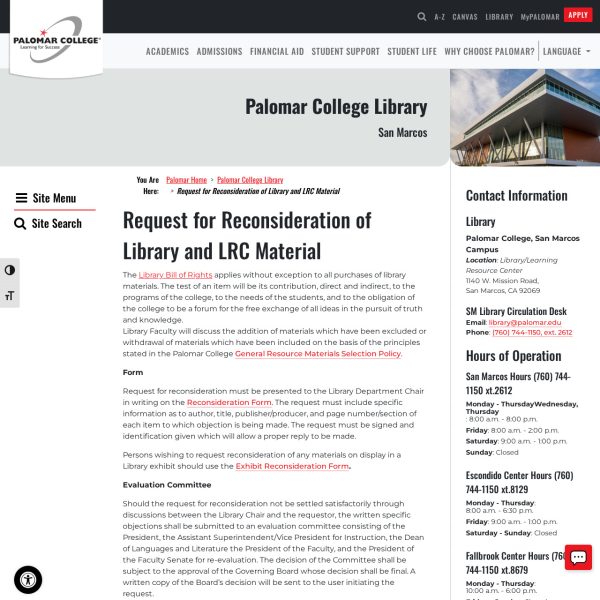
Bauer emphasizes that the librarians at Palomar take these matters seriously, stating that they are “defenders of freedom of expression.”
“Our philosophy here is not to pull the books, it’s to make them available for students unless there’s something really wrong with the book, but we normally wouldn’t purchase it then,” Bauer said.
The Palomar library not only serves its students but also provides access to printed materials to community members. As a member of the North County Higher Education Alliance (NCHEA), which includes CSUSM and MiraCosta College, the library collaborates with partner institutions to support student success.
“It’s really scary times right now for us with this administration as people who fight for freedom and fight for freedom of expression,” Bauer said. “They’re really cracking down and trying to control everything that we do. So it’s very tough times right now, and it’s going to be a really hard four years for libraries and librarians to keep fighting to keep all of the materials available for students and for the public.”
In 2024, California had 26 book ban attempts, according to the ALA. The California Freedom to Read Act (AB 1825), which went into effect in January 2025, prohibits public libraries from banning books based on content or discriminating based on race, nationality, gender identity, sexual orientation, religion, or political affiliation.
Despite these protections in California, book censorship remains a problem across the country.
Librarian Alex Doyle Bauer encourages individuals looking to make change to read books that have been banned or challenged. She also encourages people to get involved with the American Library Association and to support local libraries.
“The more educated we are, the more empathetic we can be because the more that we learn about diverse populations, the more we know that they’re just like us and the more that we can care about our peers that might be different from us because we’ve read about them in a book,” Bauer said.