
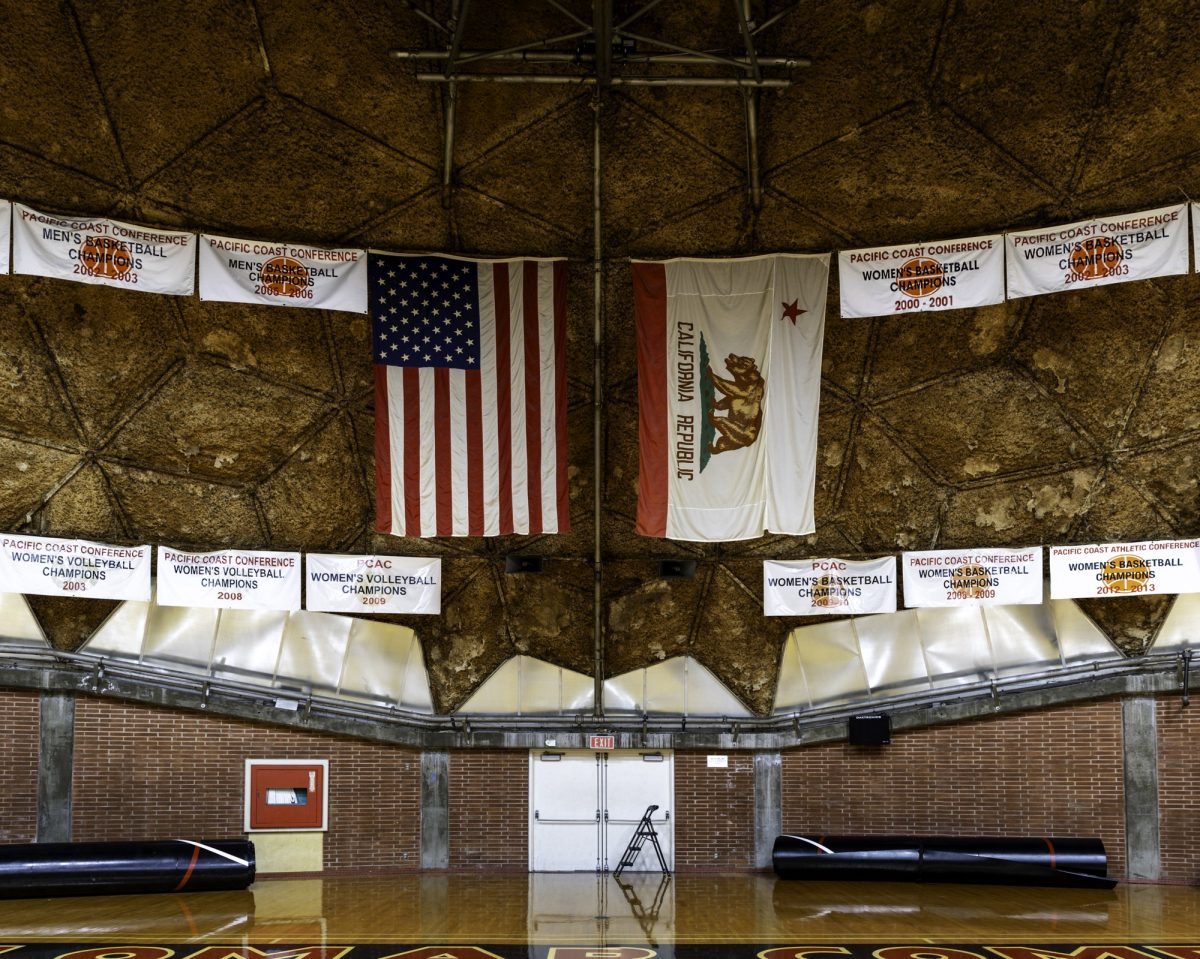
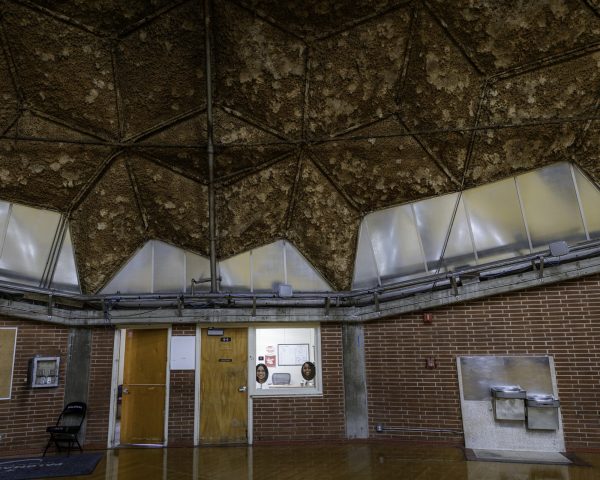
SAN MARCOS — At Palomar College’s Dome, chunks of ceiling material fall often enough that athletes dry-mop the court before practices and games, even as a long-promised interior renovation remains unfunded and off the district’s current construction lists.
Built in 1959 by Kaiser Aluminum, the geodesic Dome hosts home events for basketball, volleyball, wrestling and cheer. It remains one of the most recognizable buildings on the San Marcos campus.
Inside, coaches say, the nearly 67-year-old facility shows its age.
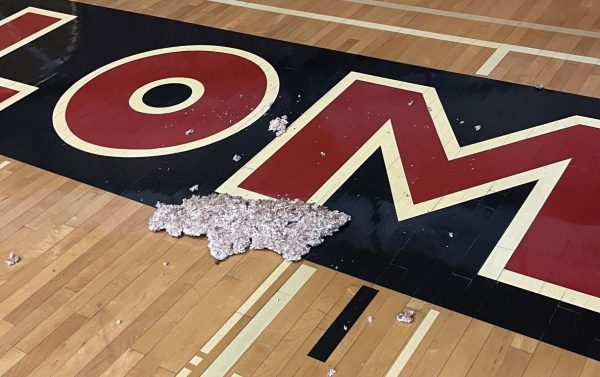
“That falls every single day, every day,” Athletic Director Daniel Lynds said, holding a chunk of material that had landed near volleyball practice. “When the temperatures become warm in the day and then cold at night, the expansion of the metal causes it to drop, and anytime a ball or something hits it, it’s gonna drop.”
For now, coaches and staff rely on constant cleaning to keep the court usable.
“We clean the court. Each team, before they practice, goes through with a dry mop and gets the little residue off,” Lynds said. “On any given day, those teams are going to clean that court before they use it. That’s four different cleanings a day outside of what facilities is already doing.”
Women’s volleyball middle blocker Dovie Daniels said players have learned to work around the debris.
“We have to clean up here and there,” Daniels said. “Sometimes the ceiling comes down and we have to shoo it off the court … Sometimes we come in and there’s a pile of the ceiling on our court and we’re like, ‘Oh, that’s nice.’”
The material on the playing surface can be more than a cosmetic problem.
“This stuff, when it’s on the court itself, gets really slippery,” Lynds said. “If you step on a chunk like this, the injury risk is there.”
For women’s volleyball coach Karl Seiler, the condition affects both safety and how the program presents itself to recruits.
“It is an eyesore from the inside,” Seiler said. “The Dome itself is a great venue to play sports in. However, it is a bit embarrassing to bring student athletes and their parents to the college and show them the interior of The Dome. Dirty, disintegrating insulation hanging and many times falling from the ceiling.”
Seiler, who has used the Dome as a student-athlete and faculty member since 1988, said insulation has been falling since he’s been at Palomar and Lynds said the problem predates his time at the college and has become part of the daily routine for multiple programs.
“It’s been long before I’ve been here,” Lynds said. “It just has never been properly addressed.”
Some staff and athletes have wondered what the falling material is made of and whether it could be dangerous. Lynds said he has been told that it is not asbestos and believes it may be a type of fire-retardant insulation, but he said athletics is cautious about speculating in a way that could force the building to close before there is a replacement space.
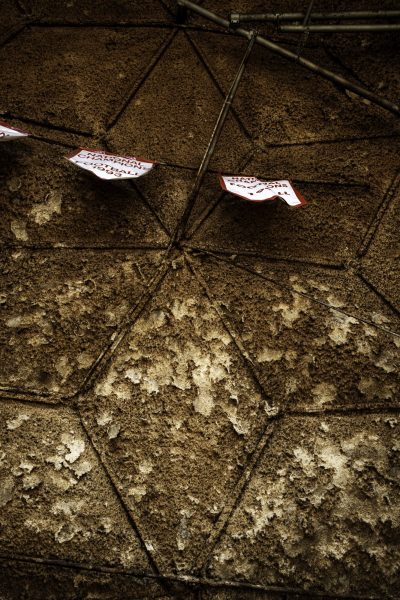
“Our biggest fear is if we push too hard on this, that they’re going to end up shutting it down,” Lynds said. “If we say, ‘Hey, this is terrible, we deal with this every day.’ They’re gonna go, ‘Well, safety issue. You guys got to get out of there.’ But, you know, that that solves the problem in a way that’s not acceptable to us. We want the problem really solved.”
In October 2022, the college completed some major work on the Dome roof. For years, storms sent water into the Dome during heavy rain. Seiler said water leaking into the gym “was always reported but facilities would not fix the problem until recently.”
In a project summary from KYA, the firm that managed the most recent roof work, states that the Dome roof had leaked “off and on since the late 1990s.”
Contractors cleaned the 42,560-square-foot shell, repaired splits and blisters, and applied a fluid-applied urethane roof system to stop the leaks and allow the structure to expand and contract with temperature changes. The company lists the total construction cost for that project at about $886,590 and says the work resolved more than 20 years of water intrusion.
The roof leaks have largely been addressed, but the ceiling material inside the Dome was not part of that project and continues to fall onto the gym floor.
Facilities Director Michael Obermiller said the district has followed its standard environmental health procedures and had the falling material tested.
“Safety of our students and employees is our number one priority, and our facilities team has been monitoring the Dome roof for many years now and cleaning regularly to ensure that there are no safety concerns,” Obermiller said. “We take environmental and safety health standards very seriously here at Palomar College, and testing is part of our standard response for any type of issue like this when it’s identified. Yes, the material has been tested and confirmed to be non-hazardous.”
According to Obermiller, facilities staff will continue to monitor and maintain the Dome while the district works through funding and planning for long-term repairs.
Beyond the falling insulation, the Dome has other aging systems that have not been fully modernized. The lighting is also a regular complaint.
“For athletics, the number one issue is lighting, lighting, lighting,” Lynds said. “Lighting is something that every time a visiting team comes in to play, they complain about. We’ve been warned by officials that it’s not up to even high school standards.”
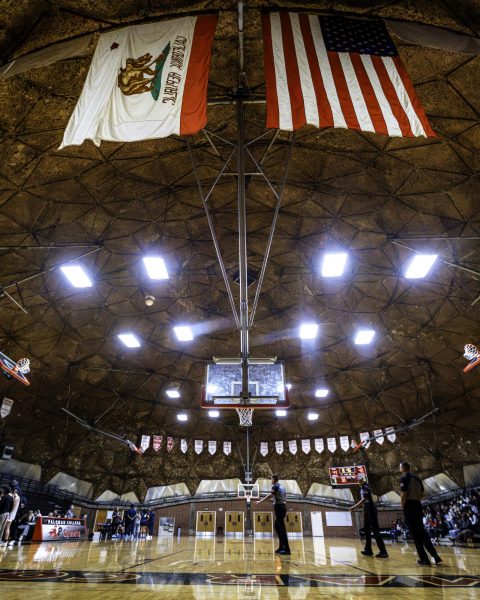
Lynds said an LED lighting upgrade has been discussed but has been tied to the unresolved ceiling issues, since work above the court would have to be coordinated. Scoreboards and other technology inside the Dome are also outdated, and an earlier concept for new video-capable scoreboards linked to a campuswide safety messaging system has not moved forward.
The Dome is one of several mid-century buildings still in use on the San Marcos campus. District planning documents group it with other core facilities from the 1950s and 1960s and note that many are at or past the typical 50-year design life for college structures.
The Dome’s long-term future has already appeared in college planning. An earlier facilities master plan proposed converting the Dome into a convention or event center and building a new gym for athletics.
That long-range vision was tied to Proposition M, the $694 million bond measure voters approved in 2006 to modernize the San Marcos campus and expand facilities. Early Prop M plans and Vision 2035 materials included a Dome remodel as part of a larger Kinesiology and Athletics complex.
The Kinesiology and Athletics project was originally placed at the end of the bond’s project list and that, as construction costs rose and new projects were added, Dome upgrades were removed from the project list in 2020 when the Palomar Governing Board reassessed how the remaining Prop M funds would be used.
“They were to waterproof the Dome roof exterior and interior, receive new lighting and new flooring,” Seiler said. “The exterior was worked on but not fully completed … That has been the extent of the upgrades to the Dome within the Prop M bond.”
Seiler also pointed to neighboring colleges that he said have built new athletic complexes in the time Palomar has been planning and adjusting its own bond projects.
“Meanwhile, most of the colleges nearest to our campus have all had new athletic facilities upgraded,” Seiler said. “MiraCosta is an example of that with an entirely new athletic complex. It is a little disheartening and confusing for our students.”
For Athletics, the bond ultimately funded the football stadium, softball field and an athletics fieldhouse that is still being completed.
Obermiller said the project to repair the inside of the Dome has now been submitted to the California Community Colleges Chancellor’s Office for state scheduled maintenance funding.
“Unfortunately, statewide funding for these types of projects hasn’t been released since the 2022–23 cycle,” Obermiller said. “We don’t have a confirmed timeline yet … Funding is our main issue.”
Facilities staff are looking at additional funding options, including redevelopment agency money and any remaining Proposition M funds, to keep the project moving forward as quickly as possible, according to Obermiller.
“The district’s long-range master plan shows the dome being fully renovated with an estimated cost of $28 million,” Obermiller said. “This large renovation will require the passage, unfortunately, of another college bond to complete.”
Recently, Governing Board trustees have received multiple presentations on a potential new facilities bond in that listed the Dome renovation, a new gym and kinesiology center and additional work at centers like Fallbrook among possible projects. In August, the governing board voted to move forward with exploring a bond survey and then in October voted not to proceed to the next step, leaving any future bond measure on hold.
For now, there is no date for when fixes might begin. Athletes and coaches continue to use the building daily while the interior ceiling material deteriorates above them, and one of Palomar’s most visible landmarks waits for the next set of funding decisions.
“It’s an older building. It has amazing architecture. The structure of it’s great,” Lynds said. “If we did invest some time and resources into it, that could be a premier venue in the state. People would love to go be there.”