

As college tuition climbs and career paths evolve, students across the United States are rethinking the traditional four-year route. Increasingly, they are turning to a faster and more affordable option: the associate degree.
Once considered a secondary credential, the associate degree is becoming a more deliberate choice for many students navigating their next steps after high school.
As technology continues to reshape the workforce, students are looking for ways to build practical skills, adapt quickly and apply what they learn in real-world settings. For many, a two-year degree offers a flexible and cost-effective starting point, whether their goal is to enter the workforce or continue their education.
Time is one of the most valuable resources in higher education. Unlike a bachelor’s degree, which typically requires four years, an associate degree can be completed in about two. This shorter timeline allows graduates to enter the workforce sooner and begin earning earlier.
An associate degree is not just an endpoint; it can also serve as a gateway to further education. Many students transfer their credits to four-year universities through articulation agreements, saving both time and money.
For Julio Ramirez, an accounting and economics major planning to transfer to a University of California campus, the value of an associate degree starts with perception.
“Having an associate degree already puts you ahead compared to not having one,” Ramirez said. “It shows commitment. Going straight from high school to college and completing a degree looks good to employers.”
 Even without immediate plans to enter the workforce, Ramirez sees the degree as a stepping stone — something that builds credibility early, especially for entry-level roles.
The “2+2” model allows students to complete general education requirements affordably at community colleges like Palomar for two years before transferring to pursue advanced studies for the second half.
It can also improve admission prospects.
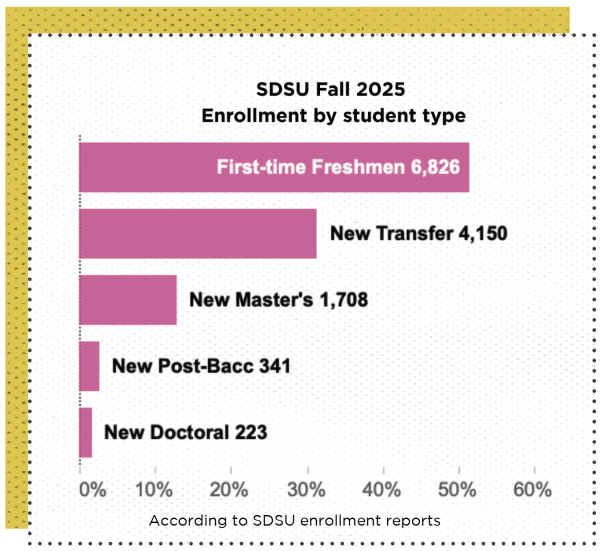
At San Diego State University, the overall first-year acceptance rate in 2025 was 37.41%, including 31.32% for in-state applicants, compared with a 54.92% acceptance rate for transfer students, according to SDSU data.
For students planning strategically, the pathway offers both financial savings and a more accessible route into competitive universities.
Heidi Alvarez Gryzbowski, an international student who earned an associate degree from Palomar College, said community college gave her both affordability and confidence as she began her studies.
 “It was more affordable and gave me time to understand how the education system works here,” Gryzbowski said.
Monica Castillo, who works closely with international students at Palomar College, said the real value often depends on what students study.
“If your associate degree gives you a specific skill, that can really strengthen your job prospects,” Castillo said. “Fields like trades or technical programs give students something concrete. They’re not just graduating with a degree, but with a skill.”
Programs in areas such as digital media, manufacturing or emerging fields like drone technology can make graduates immediately employable. In contrast, general studies degrees may require additional education or experience to stand out.
“With more general associate degrees, it can be harder because so many students have them,” Castillo added.
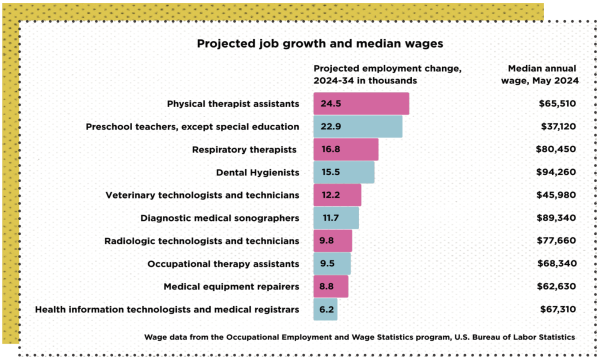
Many occupations that require an associate degree offer competitive salaries and steady job growth, according to the U.S. Bureau of Labor Statistics.
Industries such as health care, business, information technology and communications continue to seek
skilled professionals.
For example, employment of physical therapist assistants is projected to grow by about 24,500 jobs from 2024 to 2034, with a median annual wage of about $65,000 as of May 2024.
 Technical and health-related associate degrees, such as nursing or information technology, tend to offer stronger returns, while broader academic degrees are often designed for transfer rather than immediate employment.
Beyond coursework, work experience plays a major role in turning a degree into a job.
Castillo pointed to Optional Practical Training, which allows international students to work after graduation.
“Even at the associate level, getting work experience can really help students build their résumé and stand out later,” Castillo said.
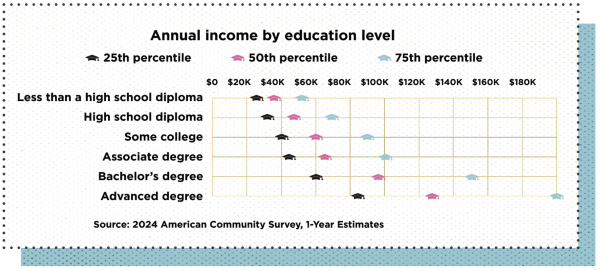
Research from the Public Policy Institute of California shows that the wage gap between workers with an associate degree and those with only a high school diploma increases over time.
 The median wage premium rises from about 69% for workers ages 22 to 27 to roughly 120% for those ages 45 to 54, reflecting steady earnings growth across careers.
The report also notes that young adults often take time to fully transition into the labor market after completing their education.
Some experience underemployment early on, working in jobs that do not require an associate degree, but many move into roles with greater opportunities for skill development and wage growth.
“My associate degree helped me get my first job because I already had basic knowledge in business and communication,”
Gryzbowski said.
Palomar College’s 2025 Career Technical Education report highlighted strong employment outcomes and career readiness among graduates, underscoring the value of associate degree programs in meeting industry needs.
For many students, the associate degree is less of a final destination and more of a launchpad.
So is an associate degree worth it?
The answer often depends on how students use it. Programs designed to develop technical skills and align with regional labor market demands provide pathways to employment and opportunities for transfer to four-year institutions.
The flexibility of the degree also allows students to balance work and education.
“You can start working sooner and still continue studying later,” Gryzbowski said.
Despite its advantages, an associate degree may not be sufficient for every career.
Professions such as engineering, education and advanced managerial roles typically require a bachelor’s or graduate degree.
For many students balancing cost, time and career goals, the question is no longer whether college is necessary, but which pathway offers the most efficient return on investment.