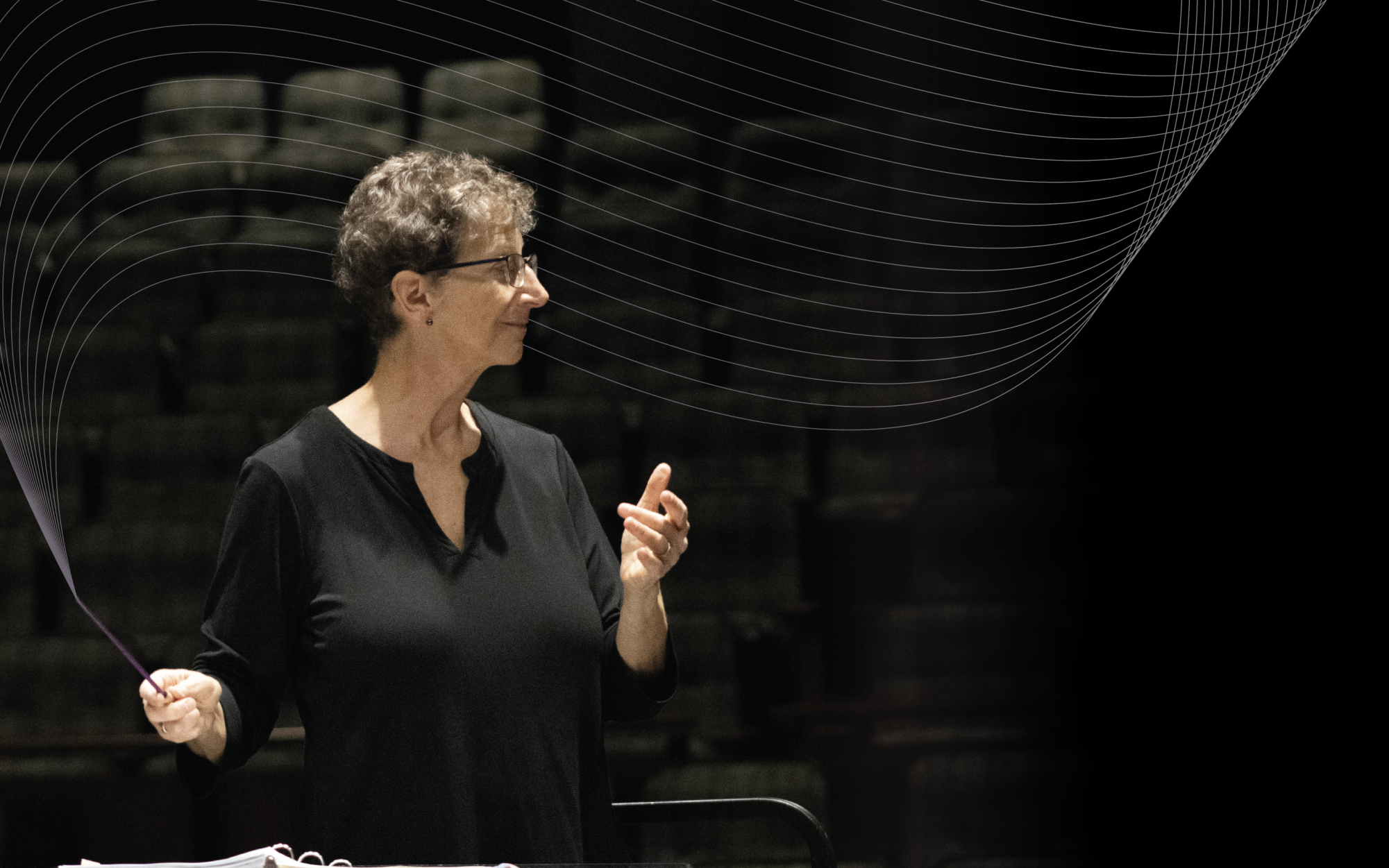

The room quiets before the first downbeat. Musicians lift their instruments, eyes fixed on Ellen Weller. From the podium, she conducts with deliberate movements — a lifted hand, a held breath, a cue that ripples outward through the orchestra. Every gesture has a purpose. Every decision shapes the sound. There is a steadiness to the way she leads, and an underlying trust between Weller and the musicians in front of her.
With a single motion, the music begins and takes shape as a reflection of something Weller has spent years building at Palomar College: a culture of discipline, connection and care, where students are pushed to work hard but supported as they grow into the challenge.
Weller, a professor and director of the Palomar Symphony Orchestra, did not originally plan to take over the ensemble. After her predecessor left shortly after she arrived at Palomar in 2005, the orchestra cycled through temporary conductors and saw a decline.
In 2011, Weller stepped in while the college searched for a permanent director. Instead, the role became
a fit.
“It was like you go out on a first date and just getting to know each other and getting to understand the culture of the orchestra. And it turned out it was a fit right from the beginning,” Weller said. “I really didn’t want to follow that authoritative, top down model. I wanted to create a culture where people felt comfortable taking risk. I want people to have a good time, really.”
Since then, she has helped grow the orchestra from about 20 members at its lowest point to more than 50.
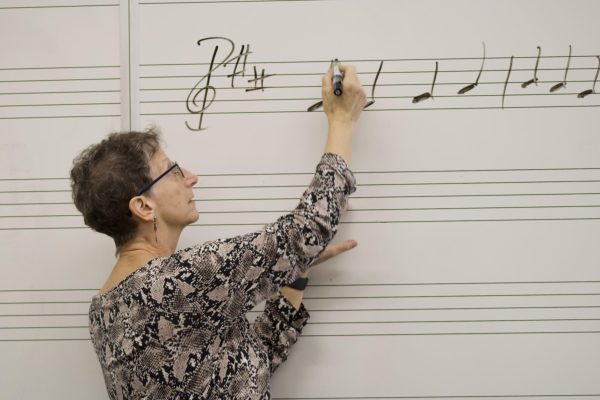
This spring, the ensemble is preparing for a three-day performance of Beethoven’s Ninth Symphony at the end of May, one of the latest examples of the program Weller has spent years rebuilding.
From the beginning, Weller envisioned a culture led by high standards, paired closely with compassion and support.
Madelyn Byrne, a Palomar professor of composition and computer music who has known Weller for about
20 years, said that balance defines her work.
“She has high standards, very high standards, but she also is willing to work hard herself and help people to meet those standards. So yes, she has that bar up there, but that’s for herself as well as for the students,” Byrne said. “The students are expected to achieve excellence. They’re expected to work hard, but everyone is welcome, and everybody can get help if they ask for it, you know, she makes it approachable. She makes it achievable for people.”
Byrne said Weller is constantly working to improve her own craft, studying scores, attending workshops and continuing to grow as a conductor.
“She goes to workshops to improve her abilities all the time. She studies scores all the time. She’s always growing and improving. She never stops learning, even though she already knows a lot,” Byrne said.
That balance between rigor and support is something students said they feel directly. Katie Lawrence, a vocalist transferring to the University of Cincinnati’s College-Conservatory of Music in the fall, said Weller changed the course of her education.
“I was a declared nursing major, and I took that one class with her, and I was a music major starting the next year,” Lawrence said. “I don’t think I was a good student until I went through the music program, and she was a huge influence on how I just approach being a student and pre-professional stuff.”
For Lawrence, Weller’s standards were demanding, but they helped her grow into a more independent student and musician.
“She just kind of helped me to just become more of an independent adult, like, you know, capable of doing my own thing,” Lawrence said. “She was, I think, really pivotal in my growth as a student. And I definitely don’t think I would be where I am now without her direct help.”
That support can also show up in small moments. Lawrence remembered breaking down during a midterm and Weller immediately responding with care.
“I was in the middle of this midterm, and I was so scared, because I knew I was just, I was bombing it. It was so bad, and I just started breaking down, and she runs to her office to get me tissues,” Lawrence said. “That’s what I mean when I’m like, she knows when to push people, but she also has such a soft side. She wants to make sure everybody’s doing okay. So it’s definitely an interesting dichotomy that you’re just like, I fear you, yet you are one of the nicest people I know.”
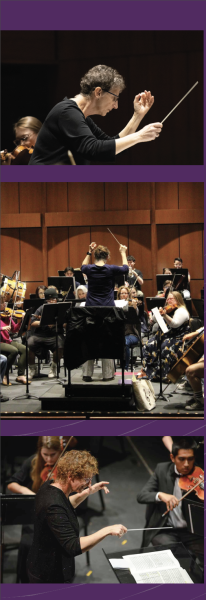
Middle: Ellen Weller conducting the orchestra’s rehearsal in 2025.(Griselda Garcia)
Bottom: Ellen Weller leads the Palomar Symphony Orchestra in a 2014 concert. (Casey Cousins/The Telescope)
More Than Musical Instruction
For Weller, teaching extends beyond music itself. She said much of her work with students involves mentorship, organization, time management and helping them navigate the pressures of being a student and performer.
“Musical instruction is the bottom of the list. I actually mentor students … So I do organizational mentoring when students get overwhelmed, they’re behind, they don’t know what to do,” Weller said. “If you’re an ensemble leader, you have to have organizational skills. You have to have time-management skills.”
Benjamin Miguel, principal clarinetist and a member of the orchestra since 2014, said students know they can go to Weller when they need guidance, even when the issue is not directly related to music.
“You just go up to her and say, ‘Hey, is there any chance we can talk about this?’ ‘Yeah, come to my office.’ And it doesn’t have to be necessarily about school. It could be about personal issues like family,” Miguel said. “She usually has a good idea. She has a lot of experiences in life. She could talk to you about anything. You can confide in her, anything.”
Shannon Yandall, a Palomar professor, San Marcos Unified teacher, principal violist and conductor for the Crescendo youth orchestra program, said Weller’s impact comes from the way she helps shape students as people.
“She goes out of her way to help shape the young adults that she comes in contact with anything they need. She will help them with their schedules,” Yandall said. “She kind of sets them on the right path, but at the same time, she’s incredibly compassionate and understanding.”
Yandall said Weller’s personality also helps students feel more comfortable.
“She’s very quirky, but that’s what makes her cool. I think that’s probably what the kids enjoy the most about her, that she’s not afraid to just be her wonderful quirky self,” Yandall said. “And I think that kind of makes everyone else feel more at ease to just be themselves and not be afraid to express themselves.”
That sense of belonging extends beyond students already enrolled at Palomar. Through youth orchestras like Crescendo, Weller sees Palomar as part of a larger musical ecosystem in San Diego County, one that can help younger musicians imagine the college as a place for them.
“And that’s something I really want them to feel. At home. I want them to feel that Palomar College is their home. This belongs to the community, and hopefully this is where they’re going to come to college for their first college experience,” Weller said.
Crescendo students frequently collaborate with the Palomar orchestra, including during the recent “Joyful Discoveries” concert, which featured eight soloists and two student conductors. For Weller, supporting those younger musicians is essential to sustaining the future of the program.
“You have to feed the roots. You have to nourish it at the roots,” Weller said.
Making the Path Visible
Weller’s commitment to opening doors for students is shaped in part by the doors that were not opened for her. Although she had talent as a conductor early on, she said she did not see women on the podium and was not encouraged to pursue conducting as a path.
“If I had known to ask just to go to school as a conducting major, I would have been turned down or dissuaded but I couldn’t even imagine it, because I didn’t see anybody who was female conducting on the podium,” Weller said.
Instead, Weller found her way gradually, first through flute, composition, piano and jazz, often in spaces where women were not fully welcomed.
“So I’ve kind of always been where I didn’t belong. And for some reason, that never stopped me,” Weller said.
Now, Weller said she tries to make sure students who are interested in conducting can see a path more clearly than she did.
“I found my way to the podium just way later than I should have,” Weller said. “It was not even a path that was made apparent to me until later. So I make sure if anybody is interested, I make myself available here at Palomar.”
That mentorship has already shaped the next generation. Weller said she is proud of former mentee Claire Lewis, who went to Juilliard for conducting, and of current student Angelica Merritt, who was given the opportunity to conduct at a Palomar concert.
“I look forward to mentoring young women, and I am proud that women can now even imagine themselves as a conductor, because they have seen someone conducting who was like them,” Weller said.
Merritt said Weller has pushed her beyond what she thought she was ready for, while still making her feel supported.
“One of the many ways in which she has supported me would be how she constantly stretches me outside of my comfort zone, and how she pushes me towards my goals and aspirations,” Merritt said. “While it is a bit nerve wracking, she always sees the potential in her students and encourages them to be more than what they think they are.”
While Weller faced challenges in her career, she said her family was never an obstacle. Her husband, Bob Weller, said music has always been central to their lives.
“We’ve been married 42 years. We’ve always been professional musicians and/or teachers. Even the two sons are professional musicians. We work hard at it,” Bob Weller said.
Bob Weller said the whole family has supported one another through their music education and careers, including two bachelor’s degrees, three master’s degrees and one doctorate.
He said what stands out most in Ellen Weller’s conducting is her energy, focus and deep understanding of music.
“The conducting is a fairly recent thing – the last 10 years or so. Most of her energy is taken up by that now,” Bob Weller said.
Ellen Weller said not every student has the same kind of support system, which is part of why she tries to create one within the program.
“We create family here,” Weller said.
 A Culture of Connectedness
The orchestra itself is more than a performance group for Weller. It is a model for the kind of community she believes people can build together.
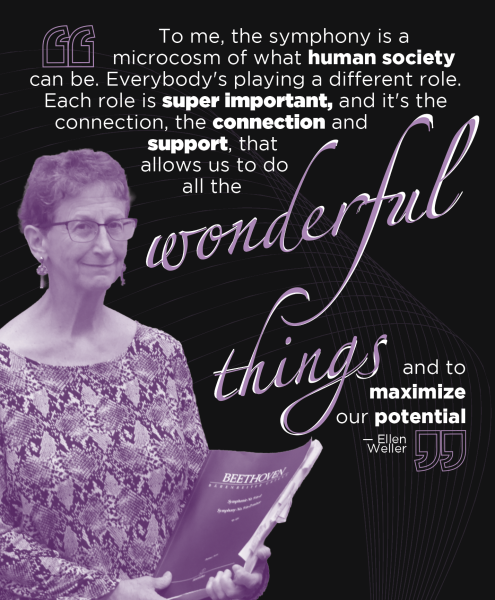
“To me, the symphony is a microcosm of what human society can be. Everybody’s playing a different role. Each role is super important, and it’s the connection, the connection and support, that allows us to do all the wonderful things and to maximize our potential,” Weller said.
As the symphony orchestra approaches its 80th anniversary, Ellen looks forward to more years of that community.
“I hope that I will be able to lead it for a couple more years. Who knows? It’s strong enough to survive without me. It’s a great tradition,” Weller said. “And the structure we have here, I think, will enable it to move forward.”
As Weller reflects on her time at Palomar, she said she feels fortunate to have had the chance to build something lasting after years of working as a part-time instructor.
“I feel super lucky,” Weller said. “I was so grateful to get the job to begin with. I remember telling the VPI [vice president of instruction], I said, ‘I want a home. I’m tired of living out of my trunk as a freeway flyer, part-timer. I want to have an office and build something.”
Madelyn Byrne said Weller’s legacy will be seen most clearly in the people she has helped.
“She always runs into former students, and they remember her so fondly, so well, and they’re so happy to see her. So I think first and foremost, all the people that she’s helped, and the level of excellence that is expected of everybody,” Byrne said.
The legacy Weller hopes to leave is not only musical. It is the culture of connectedness, care and trust that students and colleagues describe again and again.
“I feel that culture of connectedness … I really hope that our students feel that taking care of each other is important, taking care of the earth, but taking care of each other as humans,” Weller said. “I push them hard. I always have Kleenex. Sometimes it’s for me, sometimes it’s for them, but I want them to feel that this place, this was that place where they felt they could explore who they are.”